Energy costs are becoming an increasingly important consideration for modern food manufacturers. For wafer factories, biscuit producers, bakeries, and snack companies, choosing the right Wafer Stick Machine can have a direct impact on production costs, product consistency, and long-term profitability.
An energy-efficient Wafer Roll Machine is not simply a machine that consumes less power or fuel. A truly efficient wafer biscuit roll machine should also make good use of raw materials, reduce unnecessary production losses, maintain stable baking performance, and provide the right output for the factory.
From a small egg roll machine to a high-capacity Four lanes wafer roll machine, selecting the appropriate configuration can help manufacturers balance investment, production capacity, energy consumption, and product quality.
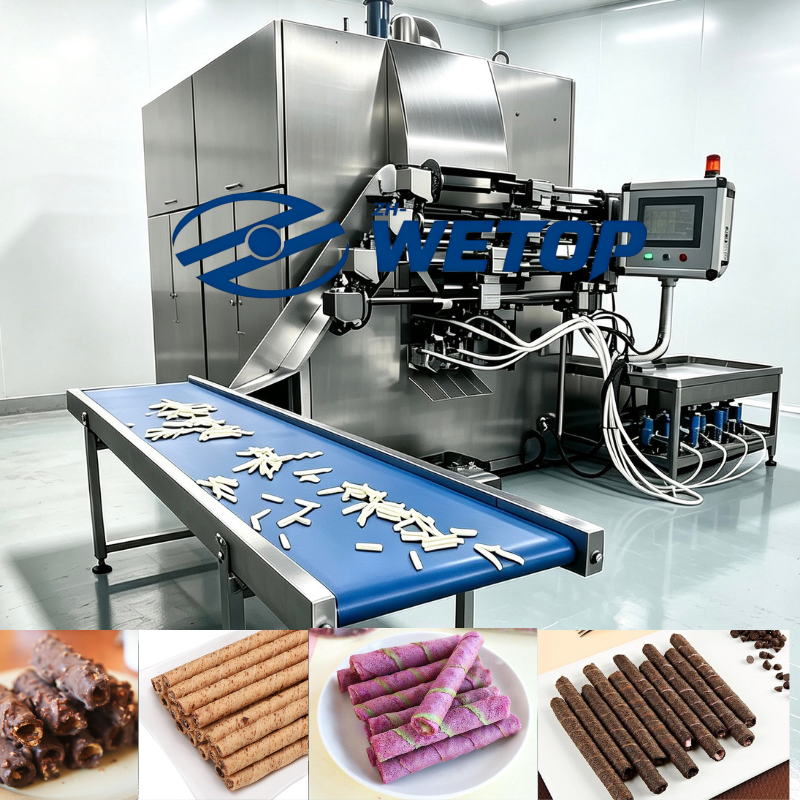
The baking section is one of the most important energy-consuming parts of a Wafer Stick Machine.
During production, liquid batter must be continuously baked into thin wafer sheets before being rolled into wafer sticks. If the baking process is unstable, manufacturers may experience:
Uneven baking
Excessive energy consumption
Over-baked products
Under-baked wafer sheets
Increased product rejection
Raw-material waste
Unnecessary production downtime
For this reason, energy efficiency should be considered together with production stability.
A high-quality baking machine should provide a stable heating environment while allowing the manufacturer to produce the required quantity of wafer products efficiently.
Buying the largest food machine available is not always the best solution.
If production demand is only 30 kg/h, installing a 200 kg/h system may result in unnecessary investment and inefficient equipment utilization.
Similarly, using a small bakery machine for a factory requiring hundreds of kilograms of products per hour can create excessive production pressure and limit business growth.
The key is to select a Wafer Roll Machine that matches your actual production requirements.
| Model | Lane Configuration | Capacity | Typical Application |
| WETOP ZH-30 | Automatic 1 lane | 25–30 kg/h | Small production |
| WETOP ZH-60 | Automatic double lanes | 60–80 kg/h | Medium production |
| WETOP ZH-80 | Automatic double lanes | 80–120 kg/h | Growing factories |
| WETOP ZH-100 | Automatic four lanes | Approx. 200 kg/h | Large-scale production |
Selecting the right capacity helps avoid both under-utilization and production bottlenecks.
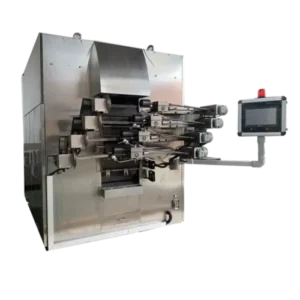
The baking oven is the core of the wafer stick roll machine.
Depending on local energy availability and factory conditions, the baking oven can use gas or electricity.
A gas-heated baking food machine may be suitable for factories with convenient LPG or natural gas supplies.
Potential advantages include:
Suitable for continuous production
Convenient for factories with existing gas infrastructure
Suitable for high-output production
Can be selected according to local energy conditions
Electric heating can be suitable for factories where electricity is readily available or where electrical heating is preferred.
Potential advantages include:
Convenient electrical operation
No direct gas supply required
Suitable for electrically controlled production systems
Easy integration into factories designed around electrical equipment
The best choice depends on local electricity and gas prices, available utilities, production capacity, and factory conditions.
Energy efficiency is only one part of reducing manufacturing costs.
Raw-material waste can also have a significant effect on the profitability of a food making machine.
A stable Wafer Stick Machine helps manufacturers reduce waste by maintaining consistent production conditions.
For example, stable batter feeding and baking can help reduce variations in:
Wafer-sheet thickness
Product size
Product color
Product texture
Rolling quality
Finished-product weight
When production is more consistent, manufacturers can reduce the amount of rejected or damaged products.
This makes the wafer biscuit roll machine not only a baking system but also an important part of overall food Processing Equipment management.
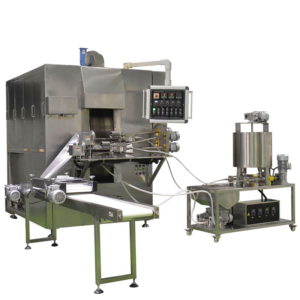
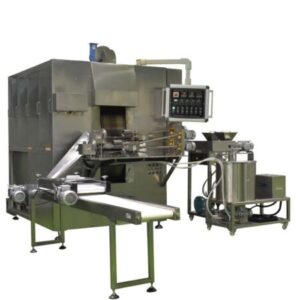
A complete wafer stick roll production line includes five main units:
Mixer
Slurry feeding system
Baking oven
Ball milling machine
Products conveyor
Each unit contributes to production efficiency.
The mixer prepares the liquid wafer batter.
Consistent mixing helps maintain stable batter quality and supports consistent wafer-sheet production.
For a Wafer Roll Machine, stable batter preparation is an important starting point for reducing production variations.
The slurry feeding system delivers batter to the baking section.
Continuous and stable feeding helps the baking machine operate smoothly and reduces unnecessary interruptions.
The baking oven converts liquid batter into thin wafer sheets.
This is the key thermal-processing section of the Wafer Stick Machine.
The oven can be configured with gas or electric heating depending on the customer's requirements.
The ball milling machine can be incorporated according to the customer's material-processing requirements.
It can help prepare selected ingredients or materials for a consistent production process.
The products conveyor transfers finished wafer products to the next production stage.
It can connect the main food machinery with cooling, coating, packaging, or collection equipment.
| Unit | Main Function | Contribution to Production |
| Mixer | Prepare batter | Consistent raw material preparation |
| Slurry Feeding System | Feed batter | Continuous material supply |
| Baking Oven | Bake wafer sheets | Stable thermal processing |
| Ball Milling Machine | Process selected materials | Consistent material preparation |
| Products Conveyor | Transfer products | Smooth downstream handling |
Together, these five machines create the foundation of a complete wafer stick roll production line.
Production lanes are another important factor when selecting a Wafer Stick Machine.
A single-lane egg roll machine may be ideal for a small manufacturer.
When production demand increases, a two ribbons wafer roll machine or Double lanes wafer stick roll machine can provide more output without requiring a completely different production concept.
For industrial-scale production, a Four ribbons wafer stick roll machine or Four lanes wafer roll machine can provide approximately 200 kg/h capacity.
| Configuration | Suitable Production Stage | Main Benefit |
| 1 Lane | Startup / small factory | Lower initial investment |
| Double Lanes | Medium production | Higher output |
| Double Lanes High Capacity | Growing factory | Increased production flexibility |
| Four Lanes | Industrial production | High production capacity |
The goal is not simply to select the machine with the highest output.
The goal is to select the most appropriate capacity for your actual production schedule.
An efficient snack machine should be able to integrate with downstream equipment.
Optional machines can help manufacturers reduce manual handling and create more consistent products.
The Mini Pillow Machine produces mini pillow-shaped wafer products.
It can help manufacturers create a new product format without replacing the main Wafer Roll Machine.
The Flatting Machine changes wafer sticks into a flat shape.
This allows the same basic wafer stick roll machine to support another product format.
A colouring machine can produce three-color wafer sticks.
Three-color products provide a visually attractive option for snack manufacturers looking to differentiate their products.
A Sesame Sprayer sprays sesame onto or inside the wafer sheet.
It can help create sesame-flavored wafer products and add another product category to the production portfolio.
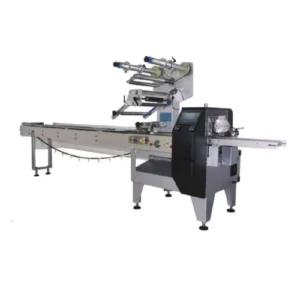
A Pillow Packing Machine automatically packs wafer sticks into pillow bags.
Connecting automatic packaging equipment with the Wafer Stick Machine can reduce manual packaging work and improve production continuity.
A Chocolate Coating Machine or Chocolate Enrobing Machine coats the surface of the wafer stick with chocolate.
This allows manufacturers to produce premium chocolate-coated wafer products using the same basic production system.
Energy efficiency does not mean producing only one type of product.
A flexible bakery food machine can support multiple products through optional equipment.
| Product | Main Machine | Optional Equipment |
| Standard wafer stick | Wafer Stick Machine | — |
| Flat wafer | Wafer Roll Machine | Flatting Machine |
| Three-color wafer | Wafer Stick Machine | Colouring Machine |
| Sesame wafer | Wafer Roll Machine | Sesame Sprayer |
| Mini pillow wafer | Wafer Stick Machine | Mini Pillow Machine |
| Chocolate wafer | Wafer Roll Machine | Chocolate Enrobing Machine |
| Retail-packed wafer | Wafer Stick Machine | Pillow Packing Machine |
This modular concept can help manufacturers expand their product portfolio without completely replacing the main food Processing Equipment.
A cost-efficient food machine requires more than energy-saving equipment.
Manufacturers should also consider how the machine is operated.
Avoid choosing equipment that is much larger than your actual demand.
Consistent batter quality helps reduce defective products and unnecessary raw-material consumption.
Consistent baking helps reduce over-baking, under-baking, and rejected wafer sheets.
Automatic conveying, coating, and packaging can reduce manual handling and improve production continuity.
If the market requires multiple product styles, optional equipment can provide greater flexibility without replacing the complete Wafer Stick Machine.
When purchasing a wafer biscuit roll machine, buyers often focus on the initial price.
However, the total cost of ownership should also be considered.
A professional Wafer Roll Machine can influence:
Energy consumption
Raw-material utilization
Labor requirements
Production capacity
Product rejection
Maintenance
Product diversification
Future expansion
Therefore, the cheapest machine is not necessarily the most economical machine.
A better approach is to choose a snack food machine that provides the right combination of capacity, stability, flexibility, and operating efficiency.
We specialize in automatic Wafer Stick Roll Machinery with different models and options for different production requirements.
Our food machinery can be configured for small, medium, and large-scale wafer production.
Capacity: 25–30 kg/h
Suitable for small snack factories, new businesses, and manufacturers starting wafer production.
Capacity: 60–80 kg/h
A Double lanes wafer stick roll machine for medium-scale production.
Capacity: 80–120 kg/h
A higher-output two ribbons wafer roll machine for growing manufacturers.
Capacity: approximately 200 kg/h
A high-capacity Four ribbons wafer stick roll machine / Four lanes wafer roll machine for industrial production.
An efficient Wafer Stick Machine should do more than bake wafer products.
It should help manufacturers make better use of energy, raw materials, labor, and production space.
By selecting the right Wafer Roll Machine, choosing an appropriate gas or electric baking system, matching production capacity to actual demand, and connecting suitable optional equipment, manufacturers can build a more efficient wafer stick roll production line.
From a compact egg roll machine to a high-capacity Four lanes wafer roll machine, every production system should be designed around the factory's real business requirements.
For companies looking to improve production efficiency while controlling operating costs, an energy-conscious wafer biscuit roll machine can be a valuable investment for long-term snack manufacturing.
Looking for an efficient Wafer Roll Machine, Wafer Stick Machine, or complete wafer stick roll production line? Contact WETOP to discuss your required capacity, heating method, product type, and customized food machinery solution.
Shanghai ZH-Wetop Food Machinery